 Shaterian

Your life, kept on your phone.
Shaterian is a quiet place for your memories, your days, and how you are feeling. It was made for older adults and for people living with Parkinson's, and it is built on one idea: what you tell it stays on your iPhone.
It is not a medical device and does not diagnose or treat anything.
Two weeks free, then $2.29 a month. For iPhone, iOS 17 or later.
Speak, and it is kept
You do not need to type, sort or fill anything in. Three things happen, in this order.
-
Tap once and talk.
Your words are transcribed on the device, tagged, and filed for you. There is nothing to organise and no forms to fill in. Take as long as you like.
-
Ask about your own life.
Ask a question out loud or type it. Shaterian answers from what you have actually told it, and shows you which memories the answer came from.
-
When it does not know, it says so.
When your own memories do not hold the answer, it says so rather than making something up.
Five rooms
The app is arranged as five rooms, one for each thing it does. The pictures show a demonstration account, not a real person.
-
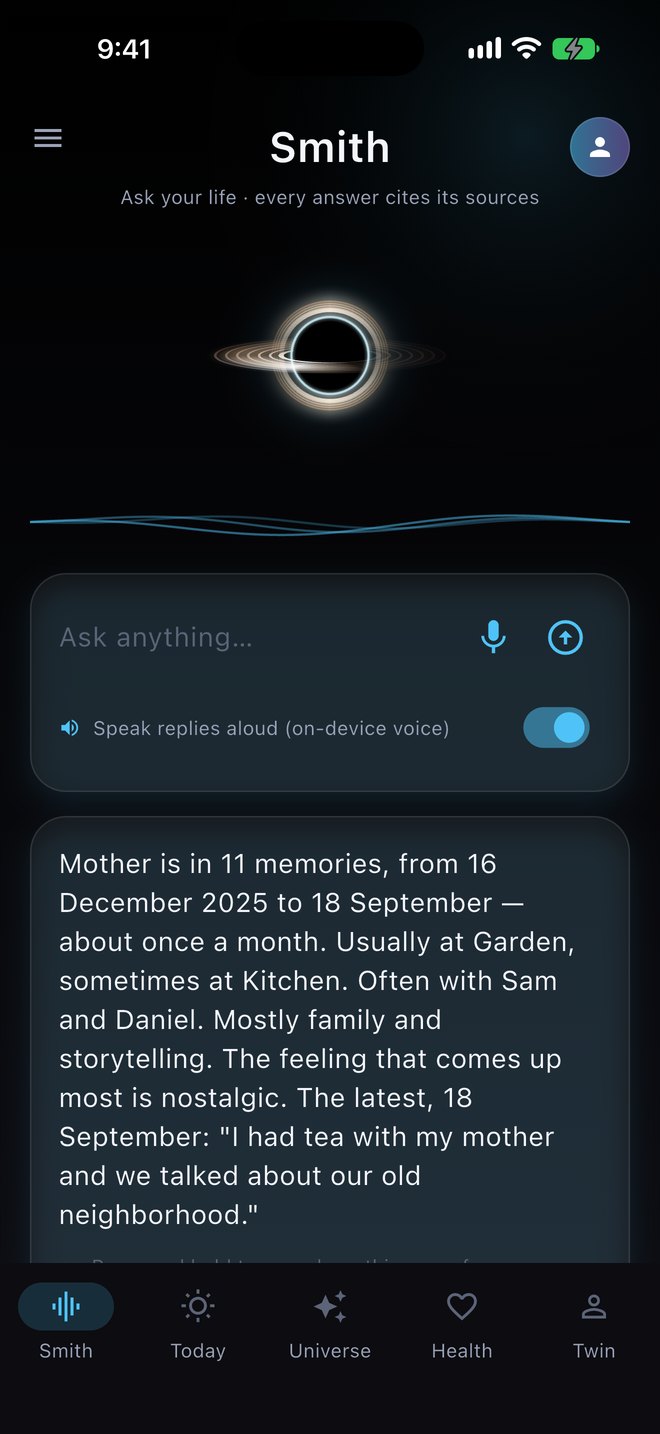
Smith
Ask about your own life. Every answer shows the memories it came from. If you like, Smith reads his replies aloud, in a voice that stays on the phone.
-
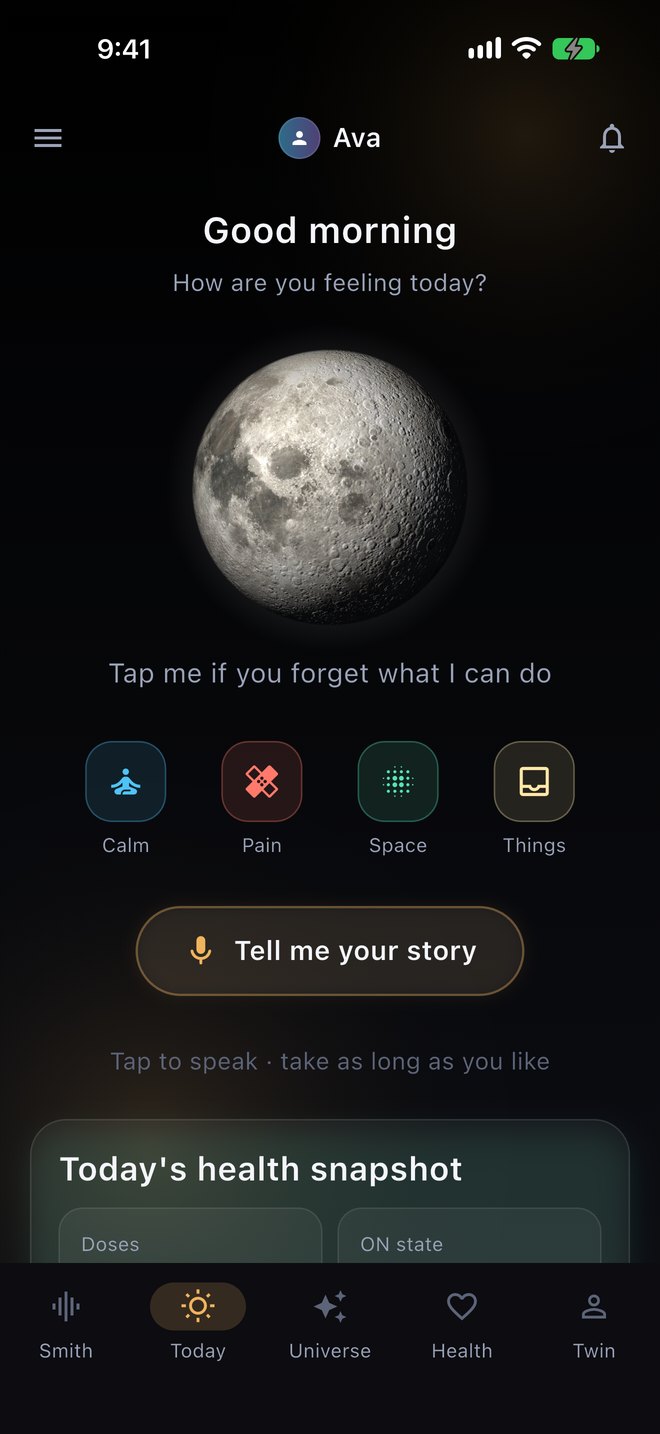
Today
Good morning, and how are you feeling. One tap to tell it your story, a gentle check-in on your mood and any pain, and a snapshot of today's health.
-
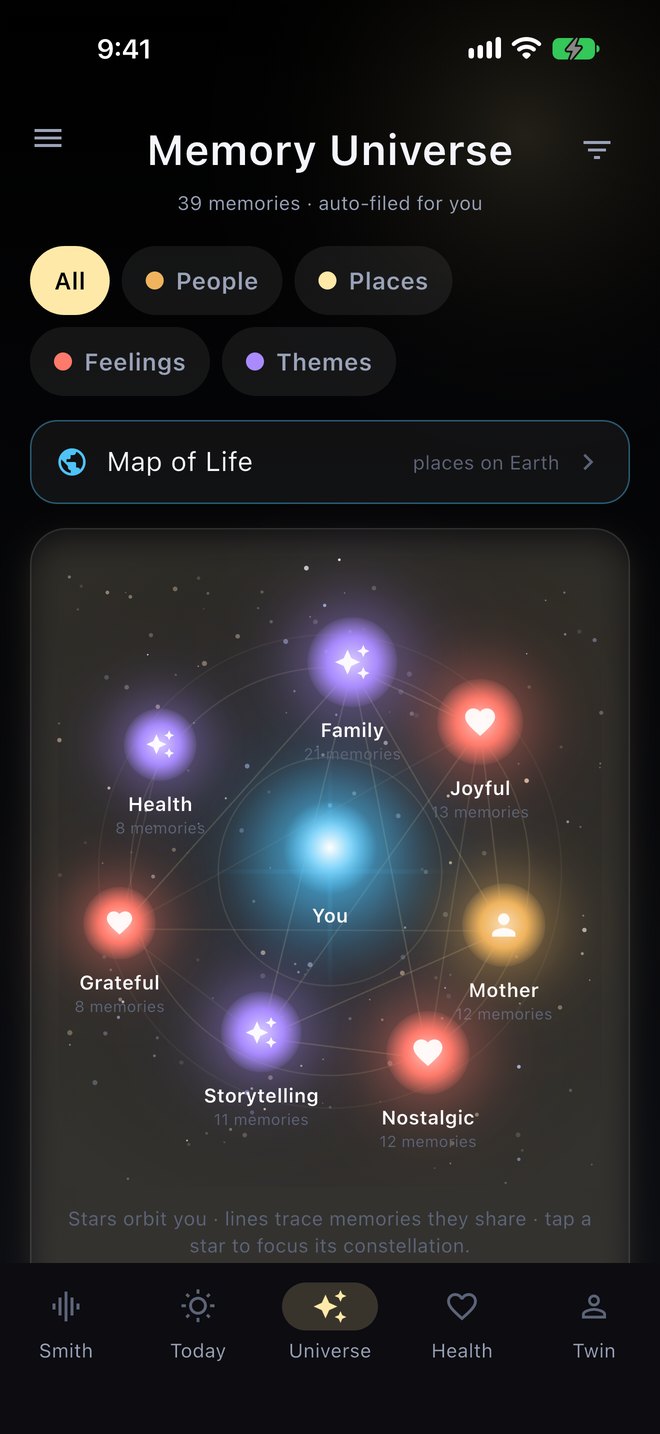
Universe
Your memories as a constellation of the people, places, feelings and themes that run through them. Follow a thread, open a cluster, or see where a memory happened on a map.
-
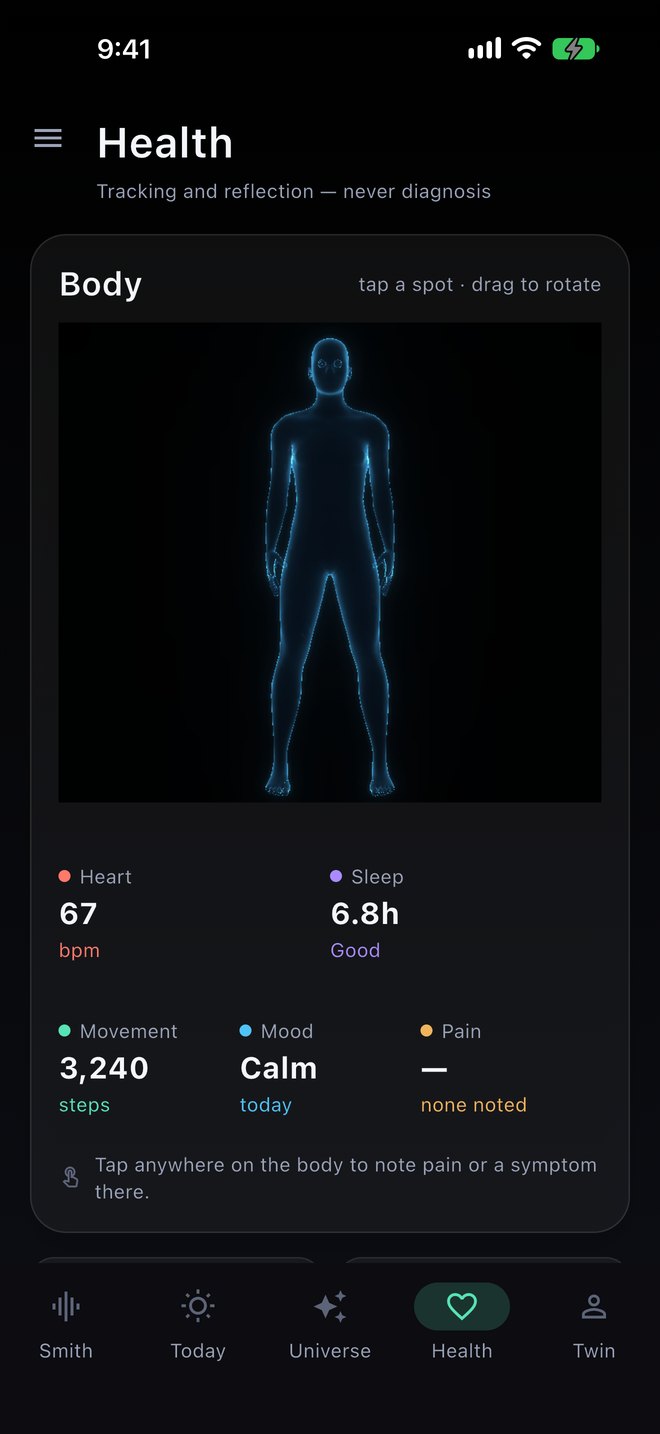
Health
Tracking and reflection, never diagnosis. Mark where it hurts on a body you can turn, see your heart rate, sleep and steps from Apple Health, log a dose and how you felt when you took it, and make a summary to show your doctor.
-
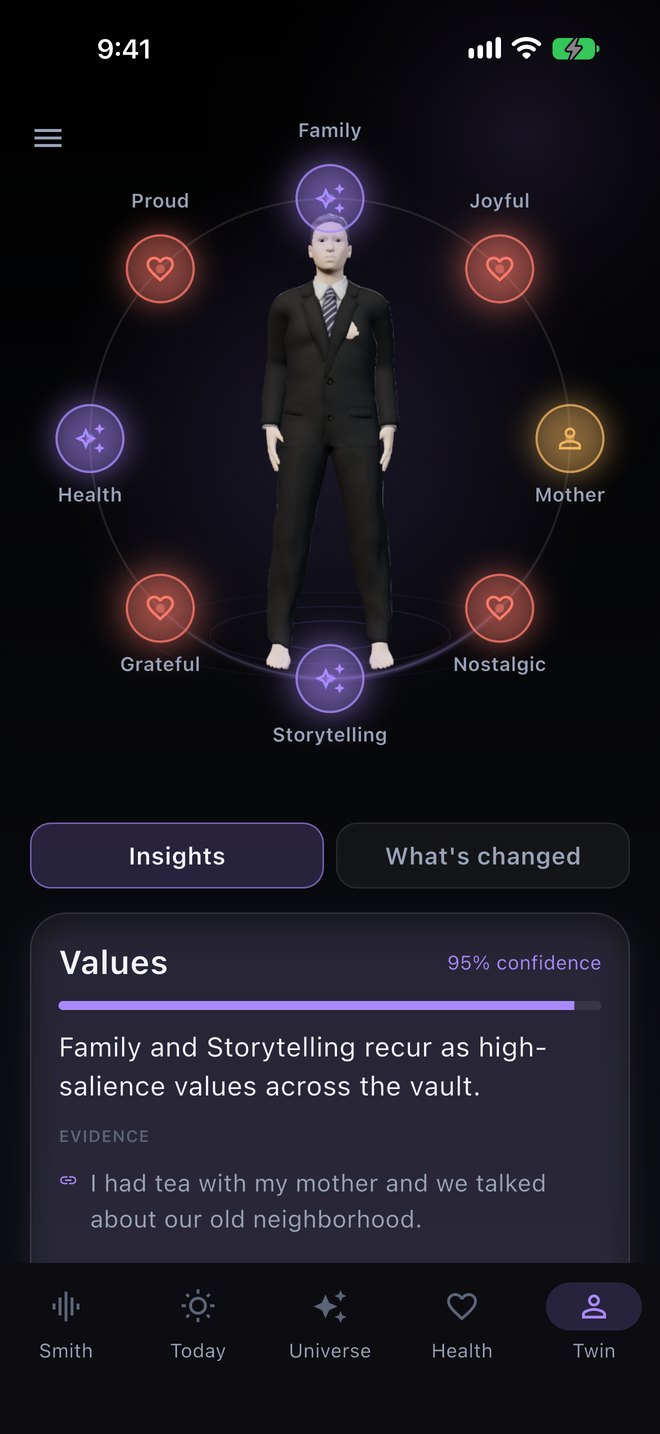
Twin
A quiet three-dimensional likeness, built from a photograph you choose, with the values and feelings that keep coming up in your memories around it. Each one shows its evidence and how sure Shaterian is.


Each month, what has changed
The Twin room compares the last thirty days with the thirty before, using only your own memories: which people and places came up more or less, and which feeling came up most.
Ask Smith "what's changed lately?" and he says the same.
It can also
-
Bring in what is already yours
Photographs, contacts and workouts can become memories, with your permission and only the ones you choose. Your calendar and Reminders are read, never copied: ask what is on today and Shaterian tells you.
-
Do things for you
Set a reminder or a routine for your pills, call or message someone, put an appointment in your calendar. It proposes, you confirm, and Apple's own screens do the rest.
A line it will not cross
Questions about diagnosis, dosage or whether to change a treatment are recognised and turned back to your own care team rather than answered by a model.
Shaterian is not a medical device. It does not diagnose, treat or give medical advice, and it is not a substitute for your doctor, nurse or specialist.
Privacy, plainly
There is no account to create and no password to remember. Signing in with Apple is optional and only tells the app your name.
Your memories, your health notes and your photograph are held on this iPhone. There is no server of ours — the one thing that can leave this iPhone is a copy in your own iCloud, and it stays off until you turn it on.
Nothing is sold, nothing is used for advertising, and nothing is used to train anything.
Two things can leave the phone, and we say so
- Turning a photograph's location into a place name, which uses Apple's geocoder.
- Speech recognition, on the rare occasion the iPhone cannot do it on the device.
Nothing else does. Read the privacy policy.
Made to be usable
- Type that grows with your iPhone's own text size, up to half again as large.
- Generous targets for unsteady hands, and no precision gestures.
- A calm, high-contrast palette. Dark for the evening, light for bright rooms.
- One quiet reminder a day, and no pressure from notifications.
Two weeks free, then $2.29 a month
Shaterian is free for two weeks, then $2.29 a month (or the equivalent in your currency), charged to your Apple Account and renewing each month until you cancel — in Settings › your name › Subscriptions, at least 24 hours before the period ends.
Your memories stay on your iPhone whatever you decide, and you can see and remove them from the app without subscribing.
For iPhone, iOS 17 or later. There is no Android version.

Who makes it
"I began building this because Parkinson's was slowly taking away my memory, my orientation, and pieces of who I am. I realized millions of people would eventually face the same problem."
Nader Shaterian
Shaterian is made by School Fab Lab, a small company in Alameda, California, and carries the surname of its founder.
Nader is a co-founder of Fab Lab Connect, a digital fabrication educator and an AI researcher. For years he kept journals, voice memos and health notes, and they were the first things Shaterian kept.
Questions
Which phones does it work on?
Any iPhone running iOS 17 or later. It can also be installed on a Mac with Apple silicon from the Mac App Store. There is no Android version and none is planned.
Do I need an account?
No. There is no account to create and no password to remember. Signing in with Apple is optional and only tells the app your name.
Does what I say leave my phone?
Your memories, health notes and photograph stay on your iPhone. There is no server of ours. Two things can leave the phone: turning a photograph's location into a place name, and speech recognition on the rare occasion the iPhone cannot do it on the device. A copy in your own iCloud is off until you turn it on.
Is what I say used to train AI?
No. Nothing is used to train anything, nothing is sold, and nothing is used for advertising.
Can it tell me about my medication or my diagnosis?
No. Questions about diagnosis, dosage or changing a treatment are turned back to your care team. The general health information in the app comes from Parkinson's UK, the Parkinson's Foundation and the NHS, and every source is listed inside the app.
Can my family or my doctor see anything?
Only what you choose to show them. The Health room can make a summary for your doctor, and it is yours to share or not.
How do I cancel?
On your iPhone, open Settings, tap your name, then Subscriptions, at least 24 hours before the period ends. Your memories stay on your iPhone whether or not you subscribe, and you can see and remove them without subscribing.
Support
If something is not working, or you have a question, write to
It helps to say which iPhone you have and which version of iOS it is running.